Kifiya is an AI ecosystem technology infrastructure company specializing in alternative data-driven decision making, intelligent financial, digital agriculture, and infrastructure. Since 2012 we have been innovating in building robust technological infrastructures and implementing transformative initiatives that address market failures. Kifiya enables micro, small, and medium enterprises (MSMEs), smallholder farmers, and low- to middle-income consumers access to appropriate and relevant financial services.
Kifiya Financial Technology is driving a major transformation in Ethiopia’s MSME lending ecosystem. Through its flagship Sustainable Access to Finance to Enable Entrepreneurship (SAFEE) program, it aims to unlock up to USD 300 million in uncollateralized loans for MSMEs from six partner banks. It aims to transform access to finance for women- and youth-led enterprises, driving financial inclusion and creating job opportunities for young people. This initiative is supported by a USD 75 million transitional liquidity and guarantee facility, along with a USD 25 million technical assistance facility. This will enable more than 477,861 MSMEs to access uncollateralized digital credit products, while providing 425,000 young women with access to mobile device financing. Over five years, the program is expected to create up to 2.18 million work opportunities for youth and support other initiatives to generate an additional 3.79 million job opportunities.
To date, Kifiya has unlocked ETB 13.3 billion ($100.3 million) in MSME lending, including nearly ETB 2.9 billion ($21 million) for 105,311 first-time borrowers, with 99% of all borrowers being women. Average first-time loan sizes span from ETB 3,639 for nano-loans and ETB 25,455 for micro-loans, demonstrating that even the smallest enterprises can now access finance. The model is driven by Kifiya’s 66 Customer Acquisition & Relationship Executives referred to as Business Development Executives (BDEs), who support MSMEs through onboarding and loan applications. Nano-loans for informal micro-businesses are disbursed instantly without manual review, while microloans for formal businesses require a one-time verification by a bank officer, typically completed in 1 to 4 minutes. To expand access to finance, Kifiya has partnered with six banks Amhara Bank, Bunna Bank, Cooperative Bank of Oromia, Enat Bank, Zamzam Bank, and Wegagen Bank to offer nano- and micro-loans for the first time, helping them reach new customer segments, particularly women microentrepreneurs.

“
I didn’t believe it at first, but I decided to try.
PROFILE
Name: Woynishet Niguse Mekonen
Age: 33 years
Business size: Micro
No. of employees: 4
Years in business: 5 years
Loan disbursed: ETB 1,677,944
Loan platform: Michu (Coop Bank)
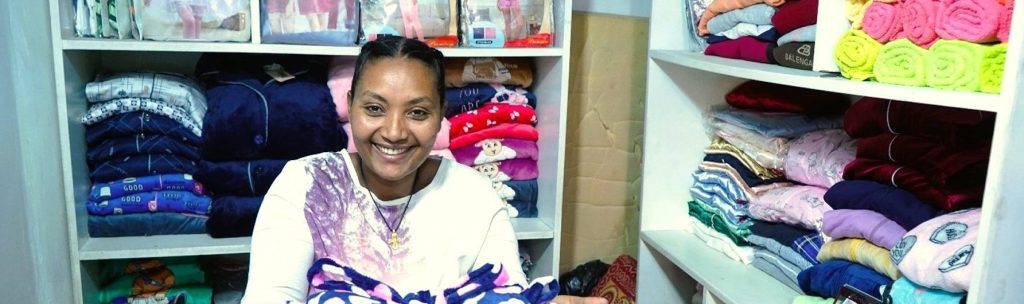
Woynishet Niguse, a single mother of two and microentrepreneur based in Bole Lemi-Kura, Addis Ababa, was first introduced to formal finance through the Michu digital lending platform of the Cooperative Bank of Oromia. At the time, she was operating a small coffee stand and had no prior access to formal credit.
Woynishet’s journey with Michu began in November 2022, during a difficult period when the COVID-19 pandemic had drastically reduced her income. She was introduced to the platform by the bank’s sales representatives while she was working at her traditional coffee stand. Intrigued, she learned about a service that offers instant loans without requiring collateral. With no revenue coming in and having already paid three months’ rent upfront for her coffee stand, she was under significant financial strain.
Her first nano-loan of ETB 5,000 offered a lifeline. She immediately used the funds to expand to two coffee stands. Over time, she also purchased a refrigerator and milk, aiming to upgrade her offering by serving coffee with milk. Previously, she had no access to formal loans and relied solely on small savings from her daily profits to meet her business needs.
Unfortunately, a prolonged power outage caused the milk to spoil, resulting in a loss of over ETB 10,000. This setback compelled her to reassess the viability of her business. Reflecting on her options, in 2023, she identified sleepwear as a more stable product with year-round demand and less sensitivity to changing fashion trends.
Since 2022, she has taken more than 39 successive loans, steadily increasing her limit to ETB 80,000. Totaling ETB 1,677,944 her consistent repayment history has not only strengthened her credit profile but also boosted her confidence to grow and formalize her business.
Woynishet launched her small sleepwear boutique in November 2023. The impact of this pivot was significant. Her sleepwear business now generates weekly revenues of ETB 100,000 to 150,000, with profits ranging between ETB 30,000 and 50,000. This financial growth has allowed her to maintain consistent inventory, meet customer demand, and hire employees to support operations, marking her transition from a street vendor to a growth-oriented entrepreneur.
In the past, Woynishet’s business income was primarily used to cover basic household expenses and her children’s school fees. With increased profits and enhanced financial stability, she has transitioned from a survival mindset to one focused on long-term growth.
She now has four employees and is preparing to open a second branch of her boutique. Her modest sleepwear shop is evolving into a growing retail network. She also has an ambitious vision to establish her own small-scale manufacturing operation in the future, reducing reliance on imports and increasing local value addition.
The additional income from Woynishet’s business has brought stability to her household, enabling her to meet her family’s needs and provide a stronger foundation for her children’s future. What was once a daily struggle to cover basic expenses has evolved into a more secure and fulfilling livelihood, allowing her to focus not just on survival but on long-term growth, both personally and professionally.
Beyond her own success, Woynishet’s journey has had a ripple effect in her community. Through informal mentorship and everyday interactions, she has shown that it’s possible to access finance, even without traditional collateral or formal education. As a vocal advocate of the Michu digital lending platform, she regularly shares her story with friends, neighbors, and street vendors. Many have followed her lead, securing nano loans, launching small businesses, and gradually expanding their operations.
Some of the people she referred now run juice bars and children’s clothing shops, reflecting how her breakthrough can ignite broader community transformation. Beyond financial advice, Woynishet fosters a sense of solidarity among local women entrepreneurs. She believes that there should be more systems to support and elevate entrepreneurs, especially women.
Successfully applying for and repaying over 39 loans has helped her build confidence in herself as a capable entrepreneur. Something she once doubted, lacking formal financial experience or support. She finally believes that she can stand on her own and achieve her independence.
Managing loan repayments has also strengthened her financial skills. With each loan cycle, she became more disciplined in tracking expenses, planning inventory, and making strategic decisions to ensure profitability. These lessons have helped her operate more efficiently and prepare for bigger opportunities, including expanding to a second location.
Beyond financial management, the experience has empowered Woynishet to think long-term. She now sets clear goals, explores new markets, and aspires to launch her own garment production line. Woynishet has grown into a visionary businesswoman; confident, informed, and determined to shape her own future.
Through her experience with Michu, Woynishet has gained not only capital but also a strong sense of confidence in her ability to manage and grow a business.
Kifiya’s partnership with the Mastercard Foundation, the Sustainable Access to Finance to Enable Entrepreneurship (SAFEE)
program, aims to enable MSME growth and resilience by expanding financial inclusion and access to productive credit at scale.
To support these strategic shifts in the market, the SAFEE program targets four key objectives:
• Facilitate and enable MSME access to affordable uncollateralized finance through credit scoring and digital lending
• Enable the design of innovative and relevant financial products and services tailored to the specific needs of MSMEs
• Enable financial institutions (particularly Banks) to embrace non-collateral lending and allocate capital for MSME growth.
• Foster a robust enabling environment for technology adoption and digital solutions in the financial sector.

Email: info@kifiya.com
Phone: +251 116 671 579